SOLUTION · CUSTOM SOFTWARE AND INTERNAL TOOLS
IoT crop monitoring and irrigation control
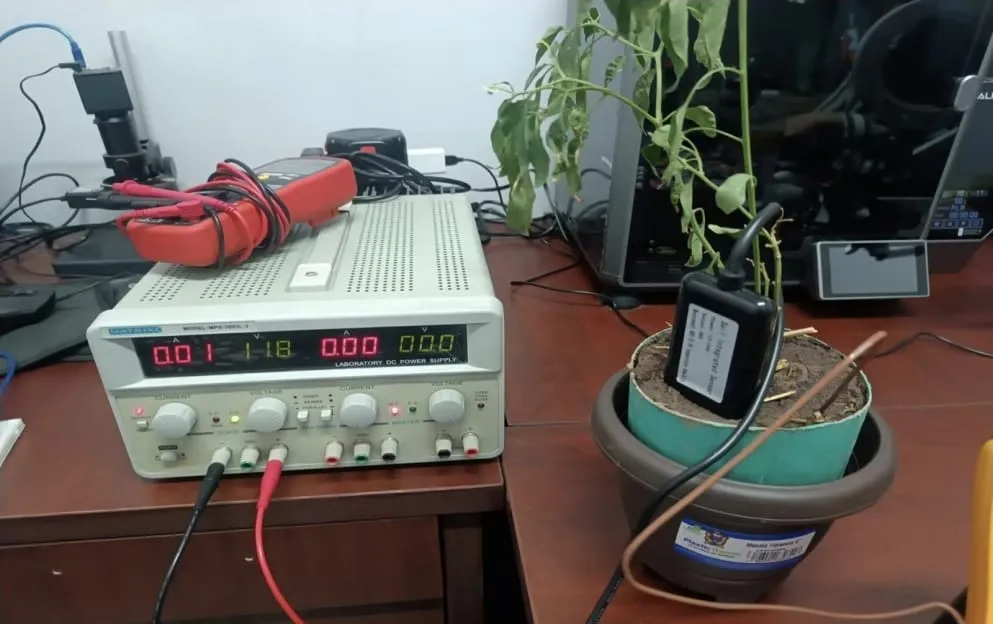
An IoT crop monitoring system brings soil moisture and weather sensor readings into a dashboard with history, alerts you when a sensor fails, and can trigger irrigation using rules or predictive models. I built PICS, a predictive irrigation system validated at FEMECI Sinaloa 2025 — a science fair in Mexico's leading agricultural state — and I apply that experience to field monitoring and control projects.
What’s happening today
Many irrigation decisions are made by calendar, by habit or by checking the soil by hand in a few spots. On large acreage or across several blocks, those checks can't be frequent or consistent: fields get overwatered where it wasn't needed and underwatered where the crop was already water-stressed. The result is wasted water and energy, or lost yield.
Soil moisture sensors and weather stations have been around for years and their price has dropped a lot. But on their own they don't decide anything: they produce numbers that are of little use if nobody sees them in time or they aren't stored with history. Those readings need to land somewhere they can be seen by block, compared over time and turned into rules or predictions that lead to concrete actions.
The field brings challenges a lab doesn't. Connectivity is limited or non-existent on many farms; power depends on batteries or solar panels; sensors drift out of calibration, get pulled up or are damaged by equipment. A useful system has to detect those failures and not irrigate blindly because a sensor reports zero due to a cut cable.
The irrigation method matters too. Automating a drip or sprinkler system with valves is very different from supporting decisions on flood or furrow irrigation, which is still common in many regions. In the second case, the value lies more in knowing when and how much to irrigate than in opening valves automatically.
How I’d solve it
- 01
What to measure and how to send it
We define which variables matter for your crop (soil moisture at one or several depths, soil temperature, air humidity) and how readings get out of the field: cellular, Wi-Fi or long-range radio such as LoRa where there's no coverage. Connectivity is evaluated first, because it shapes everything else.
- 02
Dashboard and history by block
Readings are stored with timestamps and shown by block on a dashboard that works on a phone. You see trends, compare blocks and catch anomalies: a sensor that stops reporting, impossible values or sudden changes that point to a failure.
- 03
From thresholds to models
We start with clear, explainable rules — for example, irrigate when moisture stays below a level for several consecutive readings. Once there's enough data, a regression model can estimate irrigation need from recent conditions, as I did in PICS. The model supports the decision; safety limits still rule.
- 04
Safe actuator control
If your irrigation system allows it, the software can switch pumps or valves, always with maximum run times, state confirmation and manual override. When a sensor looks suspicious, the system doesn't irrigate on its own: it alerts and falls back to manual mode.
- 05
Hardware from vendors, tested in the field
Hardware (sensors, controllers, power) is chosen with vendors according to your budget and conditions, and tested first on a pilot block. That validates the system on your soil and your crop before scaling up.
Example based on PICS
- Capacitive soil sensors measure moisture and temperature at a set interval.
- A microcontroller sends readings to the server over the available network.
- The server stores readings and shows them on the dashboard by block.
- A regression model estimates water need based on recent conditions.
- If the estimate exceeds the threshold and sensors are consistent, irrigation runs for a limited time.
- If a sensor stops reporting or returns impossible values, an alert is raised and control switches to manual.
Related work
Frequently asked questions
Is PICS for sale?
No. PICS is an academic project validated at FEMECI Sinaloa 2025 in the Basic Sciences category. It isn't a commercial product, but its architecture — sensors, telemetry, a regression model and actuator control — is a tested starting point for a build adapted to your farm.
Do I need internet in the field?
You need some way to send data, though not necessarily internet at every sensor. It can be cellular, Wi-Fi near a barn, or long-range radio that aggregates several sensors at one connected point. It's the first thing we evaluate because it determines hardware and cost.
Which soil moisture sensors should I use?
It depends on the crop, the soil and the budget. Capacitive sensors are affordable and enough for many cases; tensiometers and higher-precision sensors help when you need more accuracy but require more maintenance or investment. Some technologies lose accuracy in saline soils. We decide with tests on a pilot block.
Does it help with flood or furrow irrigation?
Yes, though the goal changes. With flood irrigation, valves aren't opened automatically, but monitoring helps decide when to order water and how long to irrigate each block, using data instead of the calendar. With drip or sprinklers, activation can also be automated.
What drives the cost?
The number of blocks and sensors, the connectivity type, whether irrigation is controlled or only monitored, power in the field and the dashboard you need. Hardware is quoted separately with vendors. A pilot on one or two blocks is the most sensible way to start.
This solution is part of my custom software and internal tools service.
Want to talk it through?
If your situation sounds similar, tell me how you work today. I’ll tell you which part is worth automating or building first.